HONDURAS
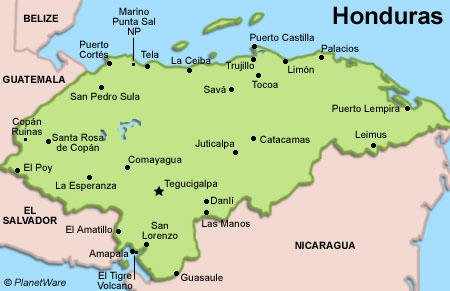
Honduras is a nation slightly larger than Virginia. Home to approximately 7.3 million people (less than the population of New York City), this democratic constitutional republic has never been able to take full advantage of its abundant natural resources and access to both the Caribbean and Pacific oceans. Tegucigalpa, the capital, is located in the Southwest of the country, while San Pedro Sula, the economic center, is located in the Northwest.
Honduras has often been considered more politically stable than many of its neighbors, and the relatively peaceful resolution of the presidential crisis in 2009 is testament to that. After the removal of Manuel 'Mel' Zelaya, the country was governed by an interim president, Robert Micheletti, until new elections could be held, resulting in the election of Porfirio Lobo Sosa.
Honduras is the third poorest country in the Western Hemisphere (Haiti and Nicaragua being one and two), with GDP per capita at $1,260 (official exchange rate), $3,130 (PPP, IMF). Until the recent global recession, Honduras' economy grew at a steady clip, but the distribution of wealth remains very polarized and averagewages remain low. Economic growth has averaged approximately 3% per year over the last decade, yet poverty levels have remained fundamentally unchanged. About 40% of the working population is considered unemployed or underemployed.
COFRADÍA
Cofradía is a medium-sized town located 15 miles southwest of San Pedro Sula, which is Honduras' second largest city and the country's economic capital.
While Cofradía can feel like a small town, it has grown substantially in the past decades thanks to its proximity to San Pedro Sula. The average BECA volunteer may only visit 6 or 7 colonias (outlying neighborhoods) during his or her year in Cofradía, however, the town boasts more than 25 colonias in toal, many of which extend for miles back towards the Sierra del Merendón. Current pop. estimate= 25,000+.

No comments:
Post a Comment